

Architecting Operational Resilience: The AI Blueprint for Airport Crisis Management
- 2026-11-09
Imagine the scene: a sudden regional airspace closure forces hundreds of international flights to instantly reroute, or busy international hubs that paralyze major hubs overnight. Sounds familiar? We have already lived through several crises in 2026 alone, and unfortunately, we know there are more to come -- we just don’t know when.
In today’s hyper-connected aviation network, a localised anomaly never stays local. Within hours, it cascades into a multi-hub operational meltdown, stranding thousands of passengers in crowded terminals and evaporating millions in commercial revenue. While modern airports have an established business continuity and crisis management protocols, effective coordination and decision-making is equally important given the inter-connected nature of aviation.
When crises strike, the traditional airport management playbook relying on static manuals, fragmented systems, and reactive triage breaks down. As airport operators, we do not lack data during a crisis; we drown in it.
Our terminals are already packed with some of the world’s most sophisticated software. Can another standalone system fix this? I don’t believe so. The trap I see across various industries is treating Artificial Intelligence as an isolated IT product rather than a strategic operational capability. If we want to transform our hubs from complex physical infrastructures into self-healing ecosystems, we must understand how AI actually creates business value.
Through my experience architecting enterprise AI strategies, I developed a core framework to evaluate true operational capability:
Capability = Intelligence × Context × Operating Model
Understanding this framework is the difference between purchasing a very expensive dashboard and building a truly resilient aviation network.
Intelligence: The Algorithmic Engine
Traditional airport management systems have long embedded "Intelligence" focused primarily on rigid algorithms and predictive analytics. The evolution of Large Language Models (LLMs) has massively expanded this horizon. Because LLMs process natural language, they can rapidly digest unstructured chaos -- dense Emergency Response SOPs, live news feeds, and radio transcripts.
But here is another truth: foundational Intelligence is rapidly turning into a commodity. Off-the-shelf natural language processing is now available to anyone with a credit card. While ChatGPT might give you decent ideas for your next vacation, you certainly wouldn't trust it to navigate your airport through a severe operational meltdown.
Intelligence alone cannot solve a crisis; it is simply an engine looking for fuel.
Context: Your Irreplaceable Fuel
If Intelligence is the commoditised engine, Context is the irreplaceable fuel. Context encompasses your proprietary, localised data, physical constraints, and historical operations.
An off-the-shelf LLM knows nothing about your airport’s unique vulnerabilities. It cannot guess that closing a specific runway disproportionately strangles your wide-body international departures, nor does it magically track the real-time staffing levels of your ground handlers or the vacant hotel rooms within a five-mile radius.
Beyond raw telemetry, true Context captures the institutional memory of your veteran operators. Imagine a newly onboarded duty manager facing their first major disruption; without deep context, they are flying blind. But by deploying LLMs to ingest years of incident logs, debriefs, and unwritten operational norms, you bake human expertise directly into the system, transforming a generic data aggregator into an intelligent operational mentor.
To unlock this, leadership must deliberately architect the Context layer, because AI cannot autonomously decide what matters most to your hub. Here are some actionable steps you could take:
- Audit and Define Critical Knowledge: Explicitly map out your true survival variables, from physical bottlenecks to protocols.
- Define Response Governance: Contextual data without a predefined workflow is useless. Establish precisely who receives alerts, what delegated authority they hold, and which secondary stakeholders are automatically mobilised.
- Architect an Auto-Updating Layer: Context degrades rapidly, and staff won't always update it manually. You need to build a dynamic data pipeline that connects aeronautical systems with live data feeds, automatically ingesting new SOPs and shift changes on the fly.
The operational difference is stark. When disruption strikes, an AI without Context simply states the obvious: "You have a four-hour delay." An AI armed with a rich, actively managed Context layer instantly calculates that a four-hour hold for 3,000 passengers will exceed terminal food production capacity within 45 minutes -- flagging the logistical gap long before it metastasises into a human crisis.
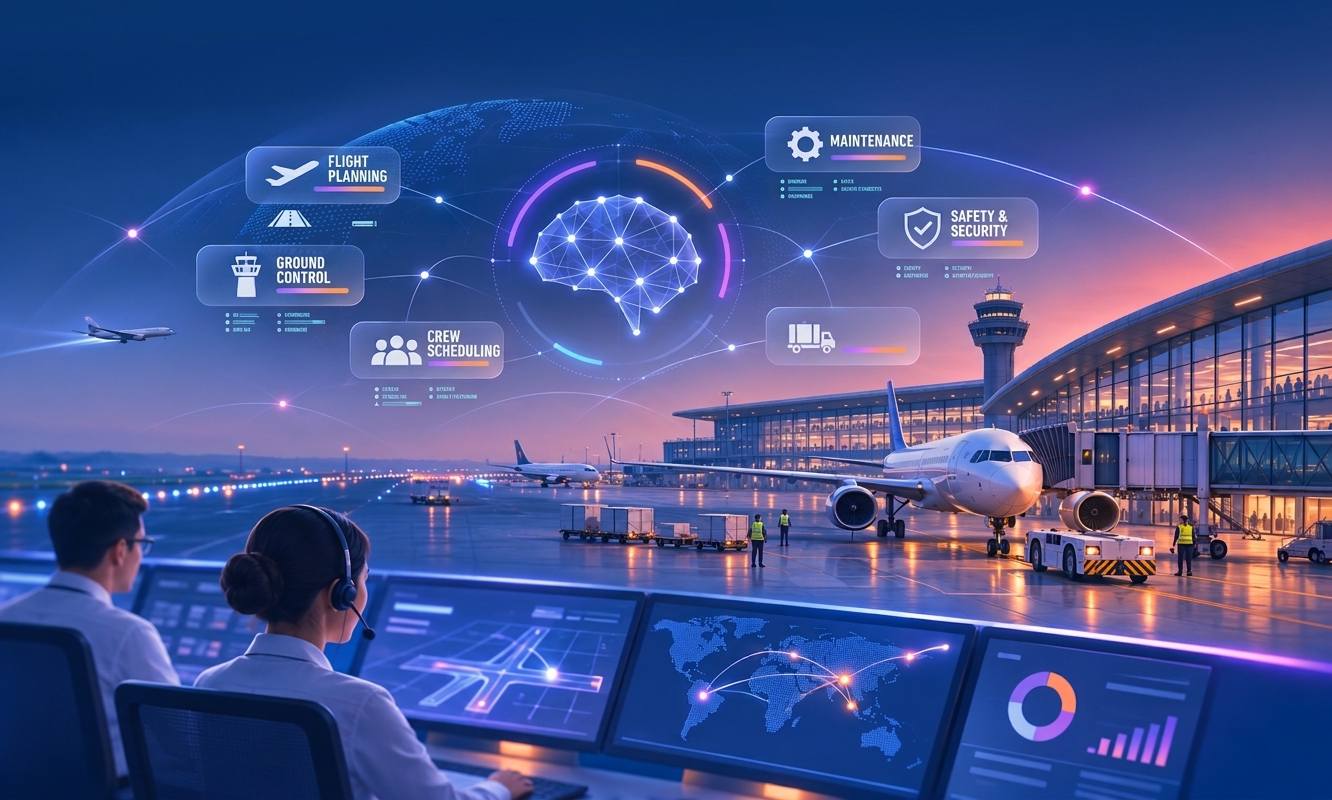
Operating Model: The Value Multiplier
This is the variable where I see the vast majority of enterprise AI initiatives fail.
Your operating model dictates governance: who decides, who executes, and what processes are followed when an AI agent flags a bottleneck.
If your AI predicts a meltdown, but your staff is still trained on three hours of manual phone calls to coordinate a response, the AI's value is zero. If you layer world-class Intelligence and rich Context onto an outdated, siloed operating model, you are merely adding expensive engineering to a broken system. You will not see the ROI.
The new Operating Model dictates how your workforce, technology, and processes interact. This means rewriting some of your legacy processes. This means active change management. This means finally breaking down the walls separating the aeronautical side and the commercial side of the house maintaining appropriate measures to protect critical airport operations and sensitive information.
This transformation won’t happen overnight, but keeping the future in mind will certainly help executives avoid expensive dead-ends that aren't future-proof.
If we manage to rewrite the operating model -- harnessing the best intelligence of both worlds (human expertise and algorithms), uniting the capacities of both the aeronautical and commercial teams, and developing true agility in data-facilitated, AI-powered decision-making -- then you become radically more effective in crisis management, exactly as you do in your day-to-day operations.
Architecting the Future: My AI-Native Terminal
If I were to design the airport of the next generation from Day 1, here’s what I imagine:
a terminal where operations are synchronised across three continuous flows -- aircraft flow dynamically reoptimising gate allocation and turnarounds on the fly; passenger flow transforming from rigid queues into a liquid, biometric continuum; and a unified data flow tearing down isolated silos to create an omnipresent nervous system linking every stakeholder from ramp to retail.
When the next regional airspace closure or air traffic control bottleneck hits, crisis management in these future-proof hubs no longer requires scrambling through manuals or hours of frantic phone calls. Instead, the system self-heals in real time.
Technology will always offer us better Intelligence. But building the airport of the future requires the courage to rethink our Context and rewrite our Operating Models.
That is the real work ahead.
About the Author:
Qihua Wang is EVP Strategy & AI at Lagardère Travel Retail, a global leader in travel retail operating in airports and transport hubs across more than 50 countries. A former strategy consultant, she has advised 20+ international companies on growth strategy, transformation, and operating model redesign. Qihua specialises in aligning business objectives with technology, data, and agentic AI to create measurable impact across enterprise strategy, M&A, and large scale transformation programs. Trilingual in English, French, and Chinese, she is a recognised thought leader on translating AI innovation into real world business value.
This article was contributed by a third party. The views expressed in the article do not represent or reflect the views of ACI Asia-Pacific & Middle East. Inclusion of any link to other external sites does not imply endorsement by ACI Asia-Pacific & Middle East of those sites and ACI Asia-Pacific & Middle East shall not be held responsible or liable for any content, advertising, products or other materials on or available from such external resources and sites.
- CATEGORY
- COUNTRY / AREA
- Hong Kong SAR
- AUTHOR
- ACI Asia-Pacific & Middle East
RELATED NEWS

- 2026-03-24
Travel retail at airports: The economics of terminal space

- 2025-07-25
ACI Asia-Pacific & Middle East shares perspectives on the development of Advanced Air Mobility in China