
Travel retail at airports: The economics of terminal space
- 2026-03-24
Travel retail at airports is often discussed through the lenses of passenger behaviour, brand mix, digitalisation, or concession models. Yet beneath all these dimensions lies a more fundamental constraint: space.
Airport terminals are spatially finite environments. Every square metre allocated to retail competes with circulation, security, gates, lounges, baggage systems, and operational infrastructure. In this context, commercial performance does not begin with merchandising. It begins with geometry.
What is the dominant constraint limiting airport commercial performance?
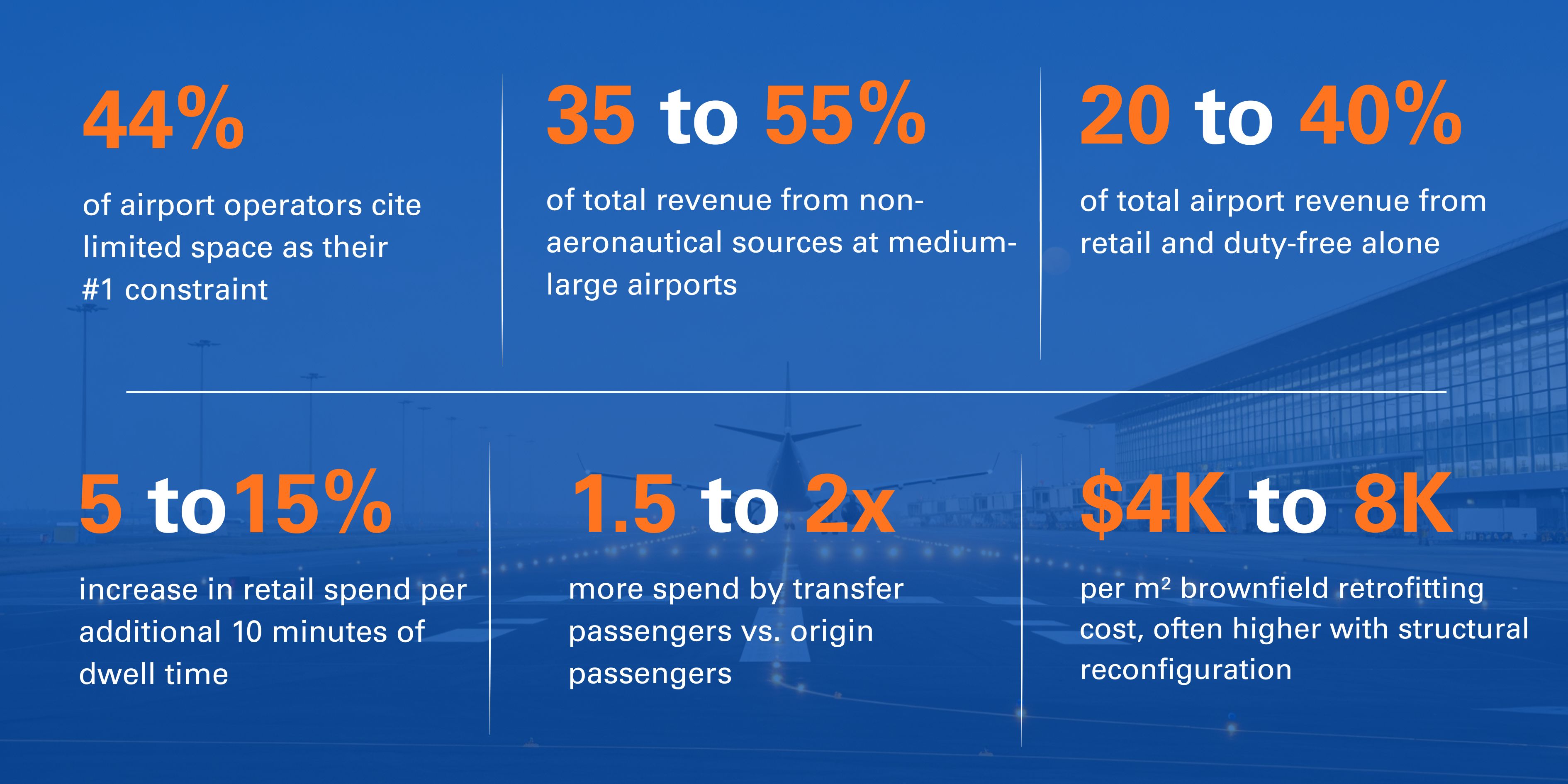
Recent operator data makes this point unequivocal. When airports were asked about the main constraints limiting commercial performance, 44% cited limited space. No other factor came close. Passenger mix shifts were mentioned by 28%, while supply chain issues, FX perception, digital capability limitations, and security constraints each received only marginal mention. Space is not a secondary issue, but rather a dominant structural constraint.
Why is space the primary economic variable?
Airports operate within a dual revenue framework: aeronautical income derived from airlines and passengers in the form of aircraft-related and passenger-related charges, and non-aeronautical income generated through retail, food and beverage, parking, and real estate. There are, admittedly, additional income streams that sit in a certain grey zone, notably revenues linked to ground handling, in-flight catering, fuel and oil concessions, and hangar facilities.
While these activities may exhibit commercial characteristics, they are intrinsically linked to airside operations and aircraft movement. For the sake of analytical clarity and simplicity, they may reasonably be considered revenues of an aeronautical nature, as they depend directly on aviation activity rather than discretionary passenger spending. Over the past three decades, non-aeronautical revenues have become indispensable to airport financial sustainability, particularly in regulated environments where aeronautical charges are capped or cannot be timely adjusted. In many medium and large international airports, non-aeronautical activities account for between 35% and 55% of total revenue, with retail and duty-free alone frequently contributing 20% to 40%.

Retail is inherently space-intensive. Unlike car parking, which scales horizontally, or advertising, which leverages vertical surfaces, travel retail requires prime passenger-facing frontage, appropriate ceiling heights, storage areas, and adjacency to dwell zones. Commercial density is therefore directly correlated with terminal design.
The concept of “retail per passenger” is widely used to benchmark performance. Yet this metric implicitly assumes comparable commercial exposure across airports, as though each passenger were operating within an identical spatial and economic environment. In reality, exposure is determined by the physical envelope of the terminal, and that envelope shapes the underlying economics.
An airport offering twice the commercial floor area per passenger benefits not only from greater space but from a different economic structure altogether. In practice, airports with limited commercial orientation may provide as little as 0.15 to 0.40 square metres of retail space per 1,000 total annual passengers, whereas commercially optimised hubs frequently operate in the range of 0.60 to 0.80 square metres, and in exceptional cases, exceed that threshold. The difference structurally alters revenue capacity. It can generate economies of scale, as higher volumes support flagship concepts and anchor tenants. It can unlock economies of scope, enabling a broader and more diversified category mix.
Greater commercial density enhances economies of density, concentrating demand within walkable retail clusters. Proximity between gates, security, and retail zones strengthens economies of proximity, increasing conversion rates. Efficient passenger flows raise economies of velocity, turning dwell time into monetisable throughput. Empirical studies consistently show that incremental dwell time translates into measurable commercial uplift. An additional ten minutes of airside dwell can increase average retail spend by 5% to 15%, while transfer passengers frequently spend 1.5 to 2 times more than origin passengers. Velocity, therefore, is quantifiable. And critically, expanded space enables greater choice, which reinforces spending by reducing substitution leakage and increasing basket size.
These structural advantages cannot be replicated through marketing campaigns, pricing adjustments, or tenant optimisation alone. They are embedded in the terminal’s geometry. Retail per passenger, therefore, is not merely a function of consumer behaviour, but the product of spatial economics. The 44% statistic confirms what spatial economics would predict: commercial growth is often constrained not by demand, but by the availability and configuration of retail space.

Why greenfield airports outperform brownfield airports?
Greenfield airports enjoy structural advantages because commercial strategy can be embedded from inception. Facilities such as Hamad International Airport or Zayed International Airport were conceived at a time when the strategic importance of non-aeronautical revenue had already been firmly established within airport economics. Commercial space was therefore embedded into the architectural logic of the terminal from the outset, rather than appended as a secondary layer. Large, centralised security checkpoints funnel passengers into expansive retail zones. High ceilings allow flagship concepts. Sightlines maximise exposure. Back-of-house logistics are integrated seamlessly.
No retrofitting is required. There is no need to relocate structural cores or reconfigure outdated systems to create retail frontage. Space is purpose-built. As a result, greenfield airports can allocate a materially higher proportion of terminal area to commercial uses. The advantage compounds over time, particularly as passenger volumes grow.
Brownfield airports: inheriting constraints
By contrast, many legacy terminals were inaugurated in the 1960s and 1970s, at a time when retail played a clearly secondary role in airport economics. Commercial activity was limited in scale and ambition because consumer society itself was more limited in scope.
Shopping as a social phenomenon has changed dramatically. Consider supermarkets several decades ago. They carried significantly fewer products, often half the assortment available today. Entire categories that now dominate shelves simply did not exist. Over the past fifteen to twenty years alone, the proliferation of brands, premium niches, lifestyle hybrids, wellness concepts, technology accessories, and experiential retail formats has transformed expectations. We now live in an economy defined by abundance, differentiation, and constant product innovation.
Airports mirror this societal evolution. Passengers today expect variety, authenticity, premiumisation, localisation, convenience, and experiential depth. Retail today is no longer transactional; it is expressive, curated, and choice-driven. Yet many brownfield terminals were designed for an earlier commercial paradigm.
.png)
While upgrades and extensions are often possible, the underlying geometry imposes hard constraints. Each additional square metre of commercial space frequently requires disproportionate capital expenditure, reconfiguration of passenger circulation, or trade-offs with operational capacity. In brownfield environments, the marginal cost of expanding terminal area can range from USD 4,000 to 8,000 per square metre, and significantly more where structural reconfiguration is required. The economics of retrofitting are therefore materially different from those of designing space at inception.
The tension is structural. Consumer society has expanded exponentially. Product ecosystems have multiplied. Retail formats have become more sophisticated. However, the spatial envelope of older terminals remains finite.
This explains why a substantial share of operators identify limited space as their principal constraint. Once spatial density approaches its threshold, incremental passenger growth may dilute rather than enhance per capita commercial performance. In an era defined by expanding choice, fixed geometry becomes the binding constraint.
Strategic implications
The structural nature of the constraint leads to a set of implications that are less operational and more architectural. First, terminal design determines long-term non-aeronautical resilience. Commercial performance is not solely the outcome of leasing strategy or tenant mix. It is embedded in circulation patterns, ceiling heights, security configuration, and the proportional allocation of gross floor area. Decisions taken at the master-planning stage reverberate across decades. Because travel retail activities frequently generate returns on invested capital in the double-digit territory, materially above the roughly 6–8% ROIC typically observed across airport operations globally, while aeronautical activities in regulated environments are generally structured to earn at best their WACC and in practice often below it, each additional square metre allocated to commercial use enhances not only revenue potential but also the blended capital efficiency of the entire asset.
Second, greenfield development must treat commercial space as core infrastructure rather than a discretionary amenity. Retail boulevards, centralised screening, flexible modules, storage, and service corridors are not embellishments. They are revenue-generating assets with long-term financial consequences.
Third, brownfield redevelopment demands disciplined capital allocation. Unlocking additional spatial capacity often requires significant reconfiguration of passenger flows and building systems. The economic case must therefore be framed not merely as refurbishment but as structural revenue enhancement capable of strengthening non-aeronautical ratios and reducing long-term reliance on aeronautical charges.
Finally, long-term financial planning, whether in a public or private ownership model, must recognise spatial capacity as a binding constraint. Airports do not need to be preparing for privatization for this to matter. Debt capacity, regulatory negotiations, aeronautical charge discussions, and capital investment plans are all influenced by the strength and stability of non-aeronautical revenue. Spatial potential, therefore, is not an abstract concept but a determinant of fiscal resilience.
The debate around airport retail often gravitates toward innovation, storytelling, and digital sophistication. Yet the survey evidence introduces a quieter, more consequential reality. When almost half of airport operators across Asia-Pacific and Middle East point to limited space as their principal constraint, the bottleneck is apparent.
Consumer demand continues to evolve. Product ecosystems continue to multiply. Passenger expectations continue to rise. But concrete does not expand at the same speed as consumer culture.
For a significant share of airports, commercial ambition is now bounded less by imagination than by square metres. The challenge is no longer simply how to sell better but how to fit more — intelligently, efficiently, and sustainably — within a finite spatial envelope.
In that sense, the future of travel retail will be determined not only by what passengers wish to buy but by what terminals were built to contain.
Sources:
ACI Asia-Pacific & Middle East Travel Retail study in post pandemic era
ACI APAC & MID Airport Commercial survey
Images: Freepik.com
About the Author

Ilia Lioutov
Head-Economics and ACI Asia-Pacific & Middle East Office
Ilia is an air transport economist with expertise in airport economics, regulatory policy, and stakeholder engagement across the Asia-Pacific and Middle East regions. His work centres on the development of sustainable airport business models, with particular emphasis on the intersection of regulation, commercial strategy, and long-term infrastructure planning.
In addition to briefly serving as the first Secretary of ANARA (Airports’ Non-Aeronautical Revenues and Activities), Ilia has led a number of research and intelligence initiatives focused on the strategic positioning of airport groups, regional connectivity patterns, and the drivers of airport competitiveness in the Middle East. His work has contributed to evidence-based policy development and regional benchmarking, supporting airports and governments in aligning infrastructure investment with evolving market needs. In his current role, Ilia advises on policy formulation, regulatory design, and strategic communications for the airport industry. He works with both public and private stakeholders to navigate complex market dynamics and regulatory environments, contributing to broader efforts to advance airport competitiveness and economic resilience.
- CATEGORY
- COUNTRY / AREA
- Riyadh
- AUTHOR
- Ilia LioutovHead of Economics and Middle East Office, ACI Asia-Pacific & Middle East
RELATED NEWS
- 2023-04-24
Eyes on China: Aviation Recovery Gathers Pace
- 2024-12-23
View from the Top