RGIA emerges as a core growth engine for Telangana: NCAER Study 2024-25
- 2026-02-24
RGIA generates ~₹68,000 crore in GVA (Gross Value Added), accounting for nearly 4.6% of Telangana’s economy & 3.5 lakhs jobs direct and induced
The economic impact assessment, conducted by the National Council of Applied Economic Research (NCAER) in October 2025, uses a robust Input–Output (IO) framework to quantify RGIA’s direct, indirect, and induced economic effects through Type I and Type II multipliers for output, GVA (Gross Value Added), and employment generation. All findings presented in this report are based on NCAER’s study.
Overview
RGIA has evolved from a greenfield PPP airport—operational since 2008—into a statewide economic catalyst that drives jobs, trade, investment attraction, and global connectivity to the city of Hyderabad and Telangana, multiplying value creation far beyond the airport boundary through supplier chains and household spending. The airport’s integrated “cityside” ecosystem, including GMR Aerocity, further expands this impact with commercial offices, hospitality, logistics, and industrial capacity that collectively deepen the region’s competitiveness.
SUMMARY AT A GLANCE:
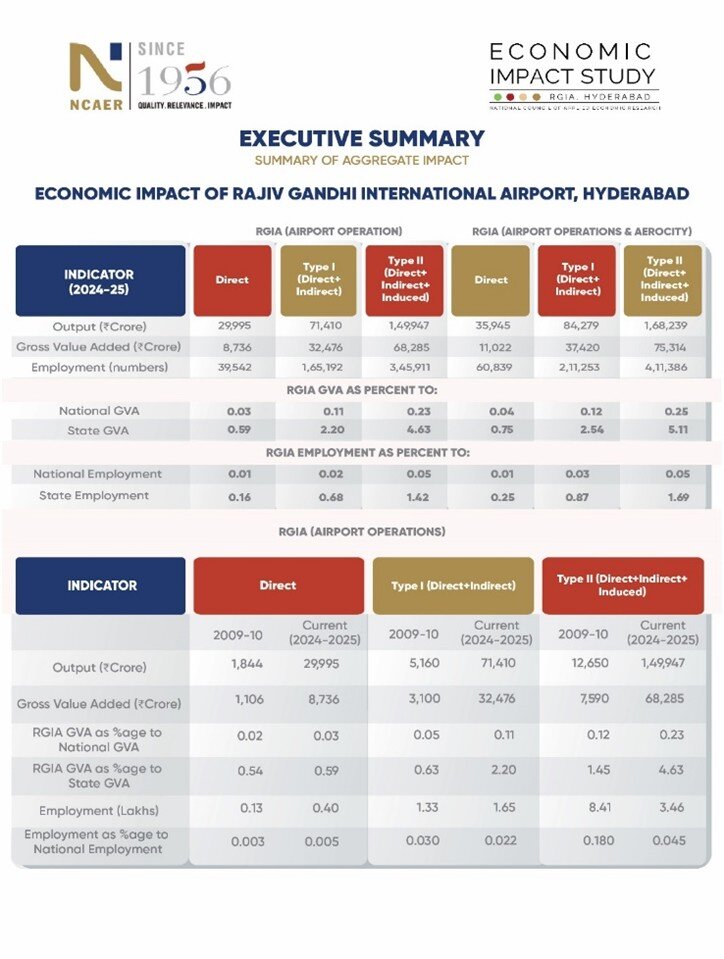
As per NCAER’s 2024–25 study, RGIA Hyderabad generates a significant economic footprint, with airport operations alone contributing ~₹30,000 crore in direct output, ~₹9,000 crore in GVA and supporting over 40 thousand jobs; this impact amplifies to ~₹1.5 lakh crore in output, ~₹68,000 crore in GVA and ~3. 5 lakh jobs when indirect and induced effects are included. By including the Aerocity, the total economic impact of the RGIA ecosystem (Airport operations + Aerocity) rises further to ~₹75,000 crore in GVA and nearly 4.1 lakh jobs, accounting for up to 0.25% of India’s GVA and over 5% of Telangana’s GVA. Since 2009–10, RGIA’s economic footprint has expanded sharply with output has grown more than fifteenfold, while value addition and employment have also increased significantly.
Future Projections & Economic Impact for 2037-38
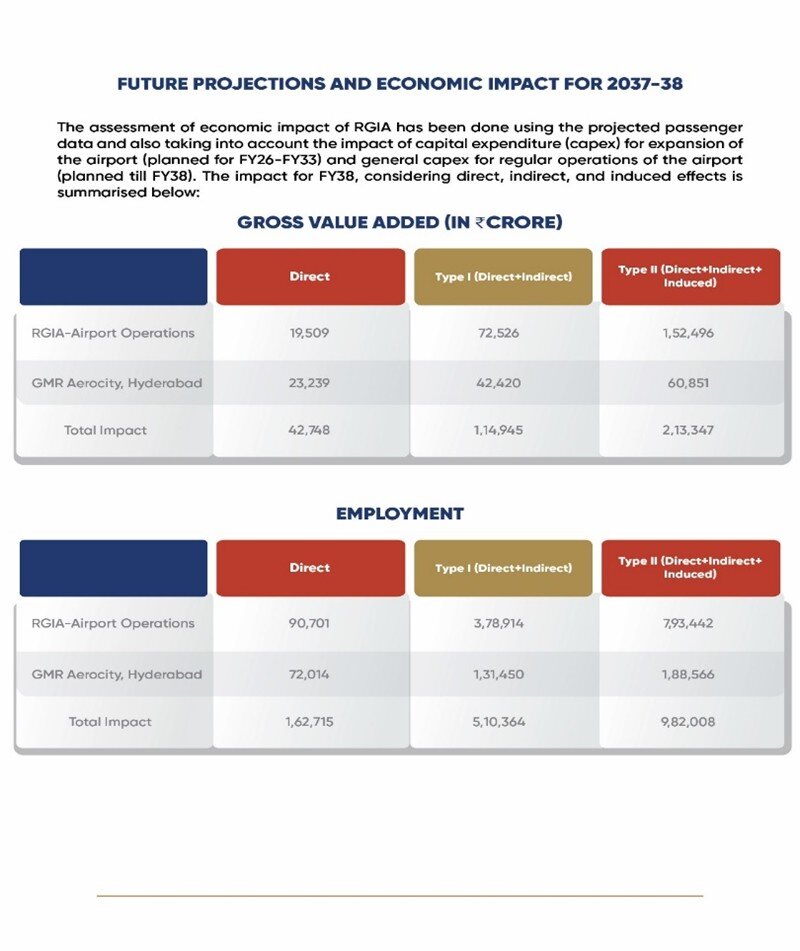
NCAER projections for FY2037–38 estimate that RGIA Hyderabad will generate a total economic impact of ~₹2.13 lakh crore in gross value added and support nearly 9.8 lakh jobs, driven by airport operations and the GMR Aerocity. Airport operations alone is projected to contribute ~₹19,500 crore in direct GVA, scaling to ~₹1.52 lakh crore with multiplier effects, while the Aerocity is expected to add ~₹60,900 crore as induced impact. Together, they position RGIA as a long term economic engine for Telangana and India.
RGIA’s Role in the Regional Economy
RGIA catalyzes value creation far beyond airport operations. The airport anchors aviation services, cargo terminal and logistics, retail and hospitality offerings, security and support services. Through interconnected supply chains and household spending of the employees engaged at airport services, RGIA’s activity diffuses across the wider economy—supporting livelihoods, enabling trade, and reinforcing investor confidence across Hyderabad and Telangana. Apart from the employees directly working within the airport boundaries, there are various services providers, such as taxi services, that are linked to the functioning of the airport. Its contribution is structurally significant relative to the state’s output, with a measurable footprint even during periods of macroeconomic stress, like the COVID pandemic.
Employment and Livelihoods
RGIA directly sustains jobs across diverse functions: airline operations, ground handling, air traffic support, warehousing, customs, pharma logistics, duty-free, food and beverage, passenger services, safety, maintenance, and administration. Beyond these direct roles, procurement and household consumption by those employed at the airport and its value chain generates additional employment across Telangana, creating broad-based livelihood opportunities. The airport workforce proved resilient through the pandemic period—contracting temporarily and subsequently rebounding above pre-pandemic levels—demonstrating RGIA’s role as a stabilizer and recovery engine.
How the Impact Multiplies
The NCAER study applies an Input–Output (IO) framework customized for Telangana state to compute how airport spending circulates through the economy:
- Type I Effects reflect direct and supplier-linked activity at the airport (fuel, catering, maintenance, utilities, services).
- Type II Effects extend to induced impacts from household consumption (housing, education, healthcare, retail, transport). In practical terms, the airport’s direct value, jobs, and output drive several multiples of total economic impact once these linkages are accounted for. The result is a pronounced amplification of both value addition and employment relative to the airport’s on-site footprint.
Trade, Exports, and the “Pharma Capital”
RGIA is a critical node for high-value export flows for Hyderabad region, particularly pharma, chemicals, and related categories. The dedicated Pharma Zone at the Cargo Terminal—supported by international certifications and advanced temperature-controlled handling facilities—has enabled the airport to maintain strong export momentum, including during periods when broader national airborne exports were under pressure. Freighter connectivity at RGIA spans the Middle East, Europe, the Far East, and Southeast Asia via leading cargo carriers, reinforcing Hyderabad’s position as a logistics hub for life sciences and time-sensitive goods.
Passenger Growth, Connectivity, and City Competitiveness
RGIA’s passenger base has grown structurally over the past decade, with a strong domestic core complemented by robust international traffic. The airport ranks among India’s highest for unique city connections, and its traffic growth rates have outpaced national averages, as well as major metro airports, across comparable periods. This connectivity fuels a virtuous cycle—linking business travel, talent attraction, tourism, conferences, and global investment—and strengthens Hyderabad’s positioning as a high-opportunity city within India’s economic geography. RGIA handled around 25 million passengers in FY24 and 29.5 million in FY25, comprising 24.4 million domestic and 5.1 million international passengers in FY25. Traffic grew from 12.4 million in FY15 to 21.7 million in FY20 (pre pandemic peak) and 29.5 million in FY25, with long range projections of 88.1 million passengers by FY38, an overall CAGR of 8.8% between FY25 and FY38. The airport currently serves 72 domestic and 24 international destinations and ranks among the highest in India for unique city connections (fourth highest), while its FY15–FY25 CAGR of 10.9% (total) and 12.4% (domestic) outpaced the national averages of 8.0% and 9.2%, respectively, reinforcing the virtuous cycle of business travel, talent attraction, tourism, conferences, and global investment.
The “Airport City” Effect: GMR Aerocity
Adjoining the RGIA, GMR Aerocity has matured into a multi-asset district integrating premium offices, hospitality and retail, cargo and logistics infrastructure, and an aerospace and industrial Special Economic Zone (SEZ). This campus delivers its own direct economic value and employment, while generating a larger total impact through supplier chains and household spending. Together, Aerocity and the airport demonstrate how integrated airside–cityside ecosystems can uplift a region’s productivity, services base, and attractiveness to global capital.
The Consolidated “RGIA Ecosystem”
When RGIA and Aerocity are viewed as one system, their combined footprint is equivalent to a significant share of state output and employment and forms a measurable fraction of national GDP and jobs. This consolidated ecosystem underpins global connectivity, accelerates sectoral diversification, and enhances Hyderabad’s export competitiveness—particularly in life sciences, technology, and advanced manufacturing.
Telangana Growth Context
RGIA’s rise has coincided with Telangana’s transformation into one of India’s most competitive state economies—characterized by strong GDP expansion, sustained per-capita outperformance relative to national averages, and rising foreign direct investment. A supportive policy environment—especially fast-track approvals and infrastructure execution—has underpinned cumulative private investments and nurtured Hyderabad’s tech and pharma leadership. The city’s innovation ecosystem, anchored by initiatives like T-Hub, has deepened demand for global connectivity that RGIA supplies. Hyderabad has rapidly emerged as one of India’s most preferred destinations for Global Capability Centres (GCCs), driven by its strong IT ecosystem, progressive infrastructure, and world class talent. It is reinforcing the city’s position as a major hub for advanced technology, innovation, and multinational operations
Infrastructure, Service Quality, and Innovation
From its inception RGIA has emphasized speed of execution, service excellence, and continuous innovation:
- Commissioned in record time after commencement of construction, RGIA quickly earned global recognition for service quality in its category.
- It pioneered India’s first dedicated Pharma Zone and led digital adoption in passenger processing with comprehensive e-boarding process.
- Capacity expansions continued through and after the pandemic, aligning airside and terminal growth with demand.
- RGIA has deployed an end-to-end Digital Twin-powered Airport Predictive Operations Centre (APOC) covering terminal, landside, and airside—improving operational foresight and coordination.
- The airport has been consistently recognized for punctuality, carbon performance, and sustainable design, with certifications under ACI and LEED frameworks.
- Airside capacity includes dual runways with long-range capability, advanced stands, and scalable terminal capacity—positioned for further growth.
Future Outlook and Investments
Looking ahead, RGIA’s direct value addition to the economy, employment, and total impact are projected to rise substantially. A multi-year capital investment program will expand northern precinct capacity, strengthen operations, and enable sustained growth. This investment pipeline creates temporary construction employment and, critically, addresses long-term operational needs across airside, terminal, cityside, cargo, and digital infrastructure. The projected expansion of cargo terminal—especially pharma and perishables will further integrate Hyderabad with global markets.
Methodology and Assurance
The impact assessment is based on an IO model calibrated to capture sectoral interlinkages within Telangana’s economy. It quantifies direct, indirect, and induced effects—mapping how RGIA’s spend and income flow through supplier networks and households. The approach conforms to established economic impact assessment practices:
- Direct: On-site operations, income, and value added.
- Indirect: Supply chain procurement and sectoral linkages.
- Induced: Household consumption effects from wages and salaries.
Assurance measures include triangulation using operational data, sectoral benchmarks, and policy context; consistency checks across cargo, passenger, and employment trends; and conservative treatment of multiplier ranges in projections.
Governance, Sustainability, and Community
RGIA’s governance model reflects PPP principles of accountability, service quality, and stakeholder alignment. The airport’s sustainability strategy integrates carbon performance, energy efficiency, and green design under recognized global frameworks. Community engagement initiatives focus on safety, employment, skilling, and local enterprise development, ensuring the airport’s growth is inclusive and regionally embedded.
Conclusion
RGIA has moved far beyond its original role as a transport hub to become a statewide economic engine that consistently amplifies value creation across Telangana’s economy. With strong multipliers, resilient cargo and export performance, superior connectivity, and the complementary Aerocity ecosystem, the RGIA footprint already accounts for over 5% of state GVA and 1.69% of state employment, while registering national relevance in GDP and employment shares. Looking ahead, targeted capex and predictive operations are poised to unlock further throughput, service quality, and ecosystem spillovers, ensuring that RGIA remains central to Telangana’s growth narrative and Hyderabad’s global competitiveness.
RELATED NEWS

- 2026-10-23
- Members’ News
Knights, Jets and local legends show travellers how to Fly the Newy Way with Newcastle Airport
- 2026-10-16
- Members’ News
Changi Airports International unveils Airport Pavement Centre of Excellence to drive airport pavement innovation